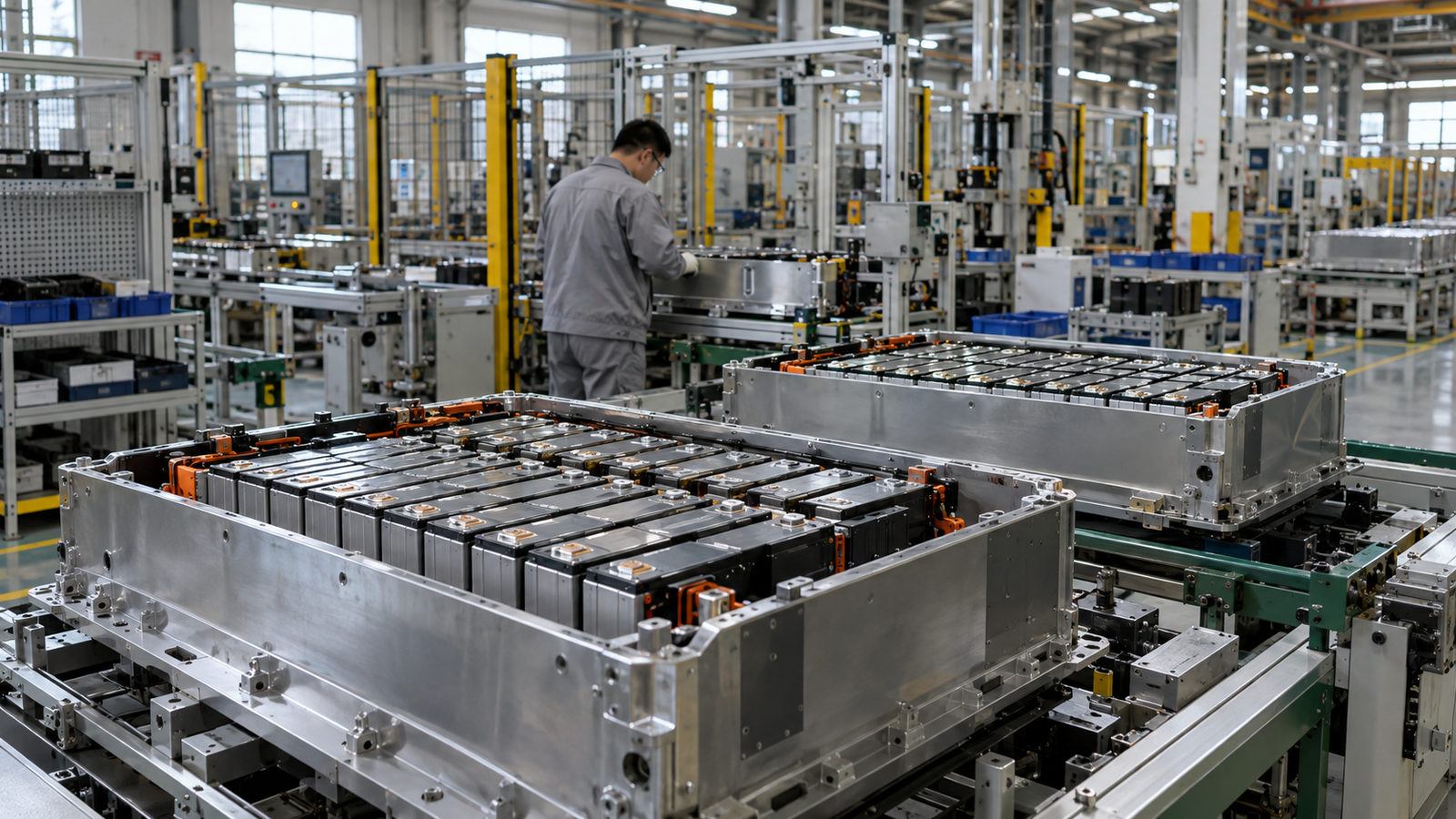
Europe’s battery storage market is being shaped by two developments at once: a sharp improvement in affordability and a highly concentrated supply chain. For equipment suppliers, understanding both is essential to building a credible European business.
China accounted for more than 80% of global battery cell production in 2025, according to the International Energy Agency. In a separate analysis, the IEA estimated that average global battery-pack prices for storage applications had fallen to roughly one-third of their 2020 level by 2025.
For suppliers, the commercial challenge is to turn that manufacturing progress into an offer a European customer can evaluate, integrate and support.
Europe wants deployment and industrial resilience
Affordable batteries can improve the economics of storing electricity for later use. Europe also has an interest in maintaining production capability, technical expertise and a more diverse supplier base.
The European Commission’s Battery Booster Strategy sets out a response across manufacturing investment, raw materials, innovation and stronger European value chains. It reflects a policy direction towards retaining more industrial value in Europe and reducing strategic dependencies.
The practical challenge reaches beyond final assembly. The IEA reports that nearly all batteries used in power grids depend on China at some stage of their supply chain. A European assembly location therefore tells only part of the sourcing story.
For buyers and suppliers, this calls for a clear account of component origins, manufacturing responsibilities and available alternatives. Eligibility for a particular funding programme or procurement process should be checked against its actual rules. A broad political ambition still has to be translated into the conditions of an individual purchase.
A battery price needs a defined scope
The fall in battery-pack prices is significant, but a European storage project also requires conversion equipment, controls, electrical infrastructure, installation and an operating arrangement.
Consider two offers with the same stated storage capacity. One may include commissioning support and defined performance guarantees; another may leave those responsibilities with the buyer or an integration partner. Differences in usable energy, operating limits, degradation assumptions and warranty conditions can change what is being compared.
A supplier should make those differences understandable. The commercial proposal needs to explain what the system will deliver under the intended operating conditions, which services are included and how responsibilities are allocated.
This gives specialist suppliers a meaningful basis for competing. A control platform that works with the customer’s assets, power electronics suited to its connection requirements or thermal management supported by relevant performance evidence can contribute to the overall offer. The contribution needs to be demonstrated for the application concerned.
Trust has to survive delivery
Supply-chain resilience becomes practical when a customer examines how the asset will be operated and supported.
Buyers should establish who can access operational controls, who approves software updates, how data is available to the owner and who responds when a fault involves several suppliers. Spare parts, service coverage and contractual responsibilities deserve the same attention. These questions apply to suppliers from every country.
Product information is also becoming more structured. Under the EU Batteries Regulation, industrial batteries with a capacity above 2 kWh placed on the market or put into service from 18 February 2027 must have a battery passport. Suppliers need to prepare the relevant information and responsibilities as part of their market offering.
For a Chinese manufacturer, European customer development may involve translating production strength into a locally supportable commercial proposition. For a European supplier, it may involve demonstrating why its particular performance, integration capability or service model justifies selection. Both need evidence that a buyer can evaluate.
Our view at Myralbe is that a durable competitive position comes from making the customer’s decision clearer: what is being purchased, how it will perform, who stands behind it and what happens when support is needed.
Turning a European strategy into commercial work
Europe provides a common strategic context, while each target market has its own connection arrangements, purchasing relationships and expectations for local support. A supplier needs to establish where its offer fits and how it will be developed there.
Myralbe supports commercial development across energy storage and grid integration, including complete systems, power electronics, controls, software and associated equipment. Our core markets are Spain, Portugal and France; wider European activity is structured around a defined mandate.
We work with suppliers to identify suitable applications and accounts, understand how buyers compare alternatives, and develop customer and partner relationships through direct local engagement. The conversations bring requirements, objections and commercial expectations back to the manufacturer.
As an opportunity progresses, we coordinate technical discussions, follow proposals and help clarify the support or integration partnerships needed to make the offer workable. Technical validation, cybersecurity assessment and product guarantees remain with the responsible specialists and contracting parties.
Customer feedback gives the supplier a basis for refining its offer, testing another application or prioritising accounts where its advantages carry weight.
Develop your position in the European storage market
If you supply battery systems, components or energy-management technology, tell us what you offer and which markets you want to develop.
Contact Myralbe to discuss the customer development, partner search and local commercial execution needed to build your business in Spain, Portugal, France or an agreed wider market.