Myralbe
International business development
We help technical manufacturers and industrial companies develop business in new markets, with the local knowledge, relationships and follow-through that work requires.
Spain · Portugal · France
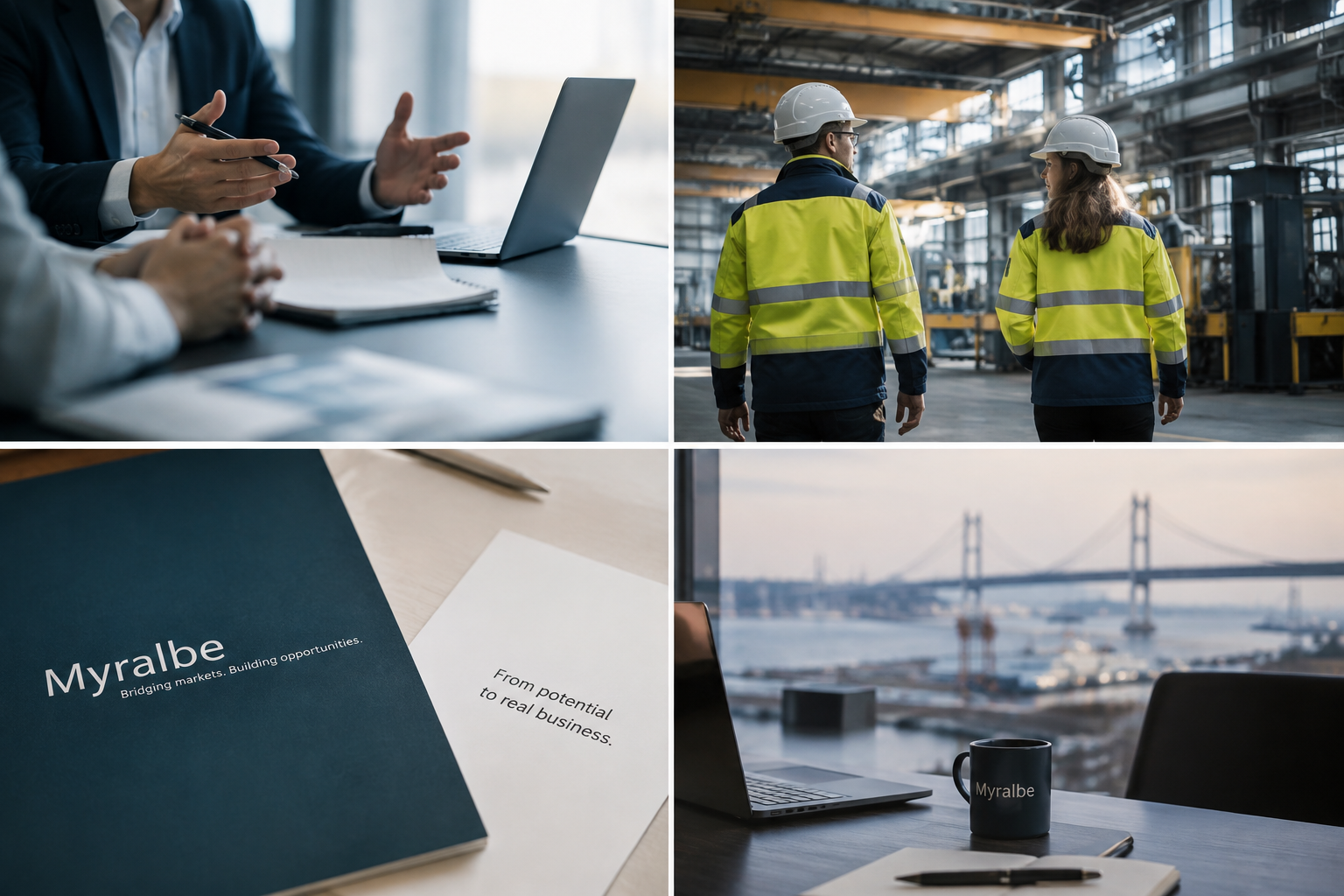
International business development
A good product needs a way to reach the people who could use it. We help technical manufacturers and industrial B2B companies build that path, principally in Spain, Portugal and France.
Read more
There are companies that reach a certain point in their history and discover that what they know how to do no longer fits entirely within the borders where they learned to do it, not because their home market has become too small, nor because growth is compulsory, a word people now use as though everything alive must keep getting bigger to prove that it is still alive, but because somewhere there is a factory, an engineering firm, an integrator, a distributor, a production manager or simply someone facing a particular problem who could benefit from what that company makes. Between them, however, lies a distance that maps do not measure very well. Madrid may be two hours from Lisbon, Paris a little over two hours from Madrid, and yet two companies separated by such a short journey can spend twenty years without knowing that they have good reasons to speak to one another. Myralbe exists in that space, which is not merely geographical.
Myralbe is an international business development company. Put like that, it sounds simple, perhaps too simple, because definitions have a way of fitting into one sentence what, in practice, takes months or years of work. We help manufacturers of technical products, industrial companies and B2B organisations develop business in markets where they do not yet have the commercial presence, local knowledge or resources needed to work consistently. Spain, Portugal and France are our principal markets, although certain projects may take us further when there is a sufficiently clear commercial reason to do so. We are not interested in planting flags on a map so that we can claim to be present in many countries; we want to understand whether a particular market really has a place for our client’s product, technology or solution, who might need it, why, when and through which people.
Understanding a market before approaching it
We research the companies, applications and people behind a buying decision, then approach them in their own language whenever possible. A contact becomes useful when we understand why that conversation matters.

Read more
This is perhaps where the difference begins between finding contacts and developing a market, two things that can look much the same from a distance but that time soon separates. A database can give us thousands of names, job titles, telephone numbers and email addresses while telling us almost nothing about who has a real problem, who has the authority to solve it, who influences a decision, who is preparing an investment, who has worked with a competitor for twenty years and has no intention of changing, or who might be willing to listen if someone took the trouble to speak to them about the right problem. That is why Myralbe’s work does not begin with a telephone call. It begins earlier, when we try to understand what our client actually makes, what need it addresses, where that solution has demonstrated value, what its limitations are, who uses it, who specifies it, who buys it and what circumstances would need to come together for someone in another country, perhaps speaking another language, to consider it worth their time and money.
This matters because international trade is full of an old misconception: that a product which has succeeded in one country can enter another through the sheer merit of its qualities, as though quality could travel alone and turn up at a customer’s door saying here I am, recognise me. It does not work like that. A good product can fail in a good market because it arrived through the wrong person, at the wrong time or with a message that meant nothing to whoever received it, just as a technically less remarkable product can establish a solid position because someone better understood the relationships, rhythms, needs and people that made up that market. Technical quality is essential, of course, but between having a solution and persuading someone to adopt it lies a long chain of human decisions, and it is precisely that chain we try to understand.
We therefore study the sectors in which we work, identify relevant companies, try to understand how those organisations are structured and distinguish, as far as possible, what looks interesting from what could genuinely become an opportunity. There are end users, machinery manufacturers, integrators, distributors, engineering firms, technical managers, buyers, production directors, project managers and other people whose titles vary from one industry to another but who share one thing: they take part in the decision in some way. Finding them is one part of the work; understanding the relationships between them is another, and it is often this second part that decides everything.
When we begin contacting a market, we try, whenever possible, to do so in the language of the person on the other side. We speak Spanish in Spain, Portuguese in Portugal, French in France and English when the international context calls for it, not merely as a linguistic courtesy, although it is that too, but because a commercial relationship begins to change when nobody has to translate mentally what they are hearing. Words are not just words when you are selling a technical solution. They carry nuances, hesitations, trust, irony, caution and doubts that are sometimes never expressed directly, and anyone working in a foreign market soon learns that understanding a sentence does not necessarily mean understanding what has been said.
Following an opportunity through
We qualify needs, decision-makers, timing and obstacles, and keep track of what should happen next. That can mean involving a technical specialist, preparing a proposal or returning when a postponed project becomes relevant again.
Read more
But making contact is not enough either. It would be convenient to measure commercial work by the number of messages sent, calls made or meetings arranged, because numbers have the advantage of looking objective and fitting neatly into a spreadsheet, but a meeting can be an opportunity or simply forty-five pleasant minutes between two polite people. What interests us is understanding what lies behind it. Is there a specific need, a project, a budget, who decides, who influences the decision, when might it happen, which supplier does the company use today, why would it be willing to change, what technical information does it need, what obstacle remains, what should happen after this conversation. These questions seem elementary when listed, yet a sales process often gets lost precisely because nobody kept asking them.
That is why we follow up on opportunities. We do so because a market does not reveal itself in a single conversation and because an industrial sale rarely accommodates the impatience of the person who wants it. Some projects are decided in weeks, others develop over months or years; investments are postponed, managers change companies, budgets disappear and return, priorities shift, machines work well enough for nobody to want to replace them until the day they no longer work well enough. An opportunity can look dead in March and become urgent in September. The difficulty is remembering it when September comes.
That continuity is a central part of our work, perhaps one of the least spectacular parts and, for precisely that reason, one of the most important. After an initial conversation, it may be necessary to involve an engineer from the manufacturer, prepare technical information, arrange a visit, understand a specification, identify another decision-maker, develop a proposal, respond to an objection or simply return six months later, when the customer said the project would be discussed again. Commercial work also consists of this quiet discipline: knowing that a conversation did not end, it was merely suspended, and not making the market start from scratch every time we speak to it again.
A company needs a memory
Myralbe MI brings together the context behind accounts, conversations and next steps. The work should leave a clearer understanding of the market, including what we learn from opportunities that do not progress.
Read more
Myralbe MI, our own commercial intelligence and follow-up environment, grew out of that same need. We do not see it simply as somewhere to store contacts, because storing information is not the same as understanding it. A company needs a memory. It needs to know whom it spoke to, what it learned, why a particular account mattered, what objection arose, who influenced the decision, what project was being prepared, what next step was agreed and why an opportunity did not move forward. Over time, what initially seemed to be separate companies begins to form a wider picture. The same integrator appears in different projects, an engineering firm comes up again, certain arguments work while others fail, a problem that seemed isolated recurs in several organisations, and what was merely information begins to become knowledge.
This distinction is essential to us. A commercial project should not end by leaving behind only a list of calls and a few completed meetings. It should leave a better understanding of the market than existed at the start. Even a lost opportunity can have value if we understand why it was lost, which competitor won, what criterion decided the choice and what difficulty we could not overcome. Some commercial defeats teach more than certain sales, although invoicing is clearly more enjoyable than learning in this way, and a company seeking to build an international presence needs to retain both: the business it won and the reasons it lost the rest.
Technical industries, different markets
Our work spans technical and industrial sectors, from energy and automation to water, packaging and equipment components. Each market has its own purchasing structures and expectations; proximity does not make two countries commercially alike.

Read more
We work mainly in sectors where technical and commercial considerations cannot easily be separated. Energy storage and grid integration, electrification and critical infrastructure, automation and intralogistics, water, recycling and industrial processes, packaging and end-of-line systems, HVAC and industrial refrigeration, technical systems for buildings and infrastructure, industrial components and solutions for equipment manufacturers are among the settings in which we can develop projects. These are different worlds, naturally, and it would be absurd to pretend otherwise, but they share an important characteristic: buying is rarely impulsive. There are specifications, operational needs, technical requirements, investments, approval processes and several people involved, and the more complex a solution becomes, the more important it is to understand the organisation that might buy it.
There is something else we learn by working between markets: geographical proximity does not imply commercial similarity. Spain and Portugal share a border, yet they are not the same market. France is close to both and has its own codes, structures and ways of doing business. Even within Spain, an industrial company in the Basque Country does not necessarily work in the same way as an equivalent company in the Valencian Community, and one sector may be organised completely differently from another in the same city. That is why we distrust formulas that promise to work everywhere. What worked yesterday in one country may fail tomorrow next door, not because the product has changed, but because the people, distribution structure, competitors, expectations or simply the way trust is built have changed.
Translating a brochure is relatively easy; translating relevance is not. You have to understand what matters to that company and that market, which problems they recognise as their own, how they make decisions, which references they consider credible and what kind of relationship they expect from a foreign supplier. That is where local presence stops being simply a matter of language and becomes a way of working.
A role that fits the project
We can help assess a market, organise entry, develop an existing presence or prepare the ground for a future local team. The manufacturer brings technical expertise; we bring market learning and keep information moving between the two.

Read more
Myralbe can join a project at different stages. Some companies come to us while they are still asking whether a particular market is worth the investment, in which case we need to research, test hypotheses and speak to enough people to understand whether there is a real basis for moving forward. Others have already decided to enter but need to turn that intention into organised commercial activity. Others have some sales, perhaps a distributor or scattered contacts, but have never managed to build a sufficiently consistent presence. There are also companies that want, in the longer term, to establish their own local team and need someone for a time who can help them learn the market, develop relationships and build a pipeline that can later become part of an internal sales organisation.
The model changes with the problem, but there is one idea we try to preserve in every case: we do not want to be a parallel activity disconnected from the client. Developing a market means getting close enough to the manufacturer to understand what we represent, know its priorities, speak with its technical teams when necessary and recognise where our own competence ends. We have no interest in pretending that we know more about a machine than the engineer who designed it, or more about a technology than the people who spent years developing it. Our role is different. The manufacturer knows deeply what it makes; we try to understand deeply the territory in which that offering needs to find customers, and between those two kinds of knowledge a bridge is built that works only if information flows in both directions.
That flow matters because the market also teaches the manufacturer. One customer asks an unexpected question, another uses the solution differently, an integrator identifies an application nobody had considered, an objection keeps recurring until it stops being an isolated objection and becomes a signal that something in the positioning needs to be reconsidered. Business development should not only carry a message to the market; it should also bring the market back to the company.
The people behind the work
Founded by Paulo Lopes, Myralbe brings together four people with backgrounds in sales, finance, technology and the humanities. According to each project’s needs, we can also draw on more than twenty collaborators and professional contacts across more than eight European countries.
Read more
Founded and led by Paulo Lopes, Myralbe draws on a professional background built over more than fifteen years in B2B sales, international development, partner management and European markets, a substantial part of it developed from the Netherlands. Years spent working between different companies, countries and cultures teach a kind of commercial humility that is difficult to find in manuals: the awareness that what seems obvious to the seller may have no importance at all to the buyer, that relationships between companies are always made up of actual people, and that a market cannot be won with a PowerPoint presentation. It can be studied, worked on, understood and, given enough time, perhaps won, although even that word deserves some caution, because no customer belongs to anyone and no market position lasts forever.
We are a team of four, with backgrounds in sales, finance, technology and the humanities. That combination allows us to look at a project from several perspectives: the commercial relationship, its economic viability, the technical solution and the people involved in a decision.
Depending on what a project needs, we can also draw on a network of more than twenty collaborators and professional contacts. That network reaches more than eight European countries, including Spain, France, Portugal, the Netherlands, Italy, Poland, Germany and Hungary, with contacts in the Nordic region as well.
Perhaps this is, in the end, the simplest way to explain what we do. There is a company that knows how to make something, and somewhere there is another company that might need what it makes. Between them lie distance, unfamiliarity, competition, language differences, commercial habits, organisational structures, doubts, risks and all the small difficulties that make a relationship which seems obvious once established look improbable before it exists. Myralbe works precisely in that space.
We try to find where the right companies are, who the right people are and whether there is a genuine reason for them to speak. We make contact, listen, learn, qualify, accompany, organise the information and continue as long as there is a commercial path that makes sense. When that path does not exist, recognising it matters too, because developing business does not mean turning every no into a yes. It means distinguishing final refusals from those that mean not yet, and the yeses that have substance from those that are simply a polite way to end a conversation.
Perhaps this is ultimately what a manufacturer wants when it decides to enter a new market: not someone who promises an entire country, because nobody can reasonably promise such a thing, but someone willing to enter that country company by company, person by person, conversation by conversation, accumulating knowledge where there was unfamiliarity, relationships where there was distance and opportunities where there were only possibilities.
Some products cross borders inside a box.
Markets, however, are crossed in another way.