An automation quotation can reach the purchasing team while important questions remain unanswered. Who takes responsibility for the completed installation? Which software configuration is included? Who will resolve the interfaces between a new machine and the equipment already on site?
For an international manufacturer developing customers in Spain or Portugal, those gaps can delay an otherwise promising opportunity. The EU Machinery Regulation makes the approaching 2027 transition a useful reason to clarify them early.
Check the project timeline before fixing the offer
The European Commission confirms that Regulation (EU) 2023/1230 generally applies from 20 January 2027, replacing the Machinery Directive. Its changes include provisions for safety-related digital technologies and clearer conditions for digital instructions.
A purchase-order date alone does not establish which regime applies. The project team should verify the product’s first placing on the EU market, or putting into service where relevant, and the transitional provisions for products already placed on the market.
The commercial consequence is practical: delivery assumptions need technical confirmation. When a customer moves its schedule or changes the installation scope, the supplier should ask whether the documentation, assessment work and responsibilities in its proposal still match the project.
A combined installation needs an agreed scope
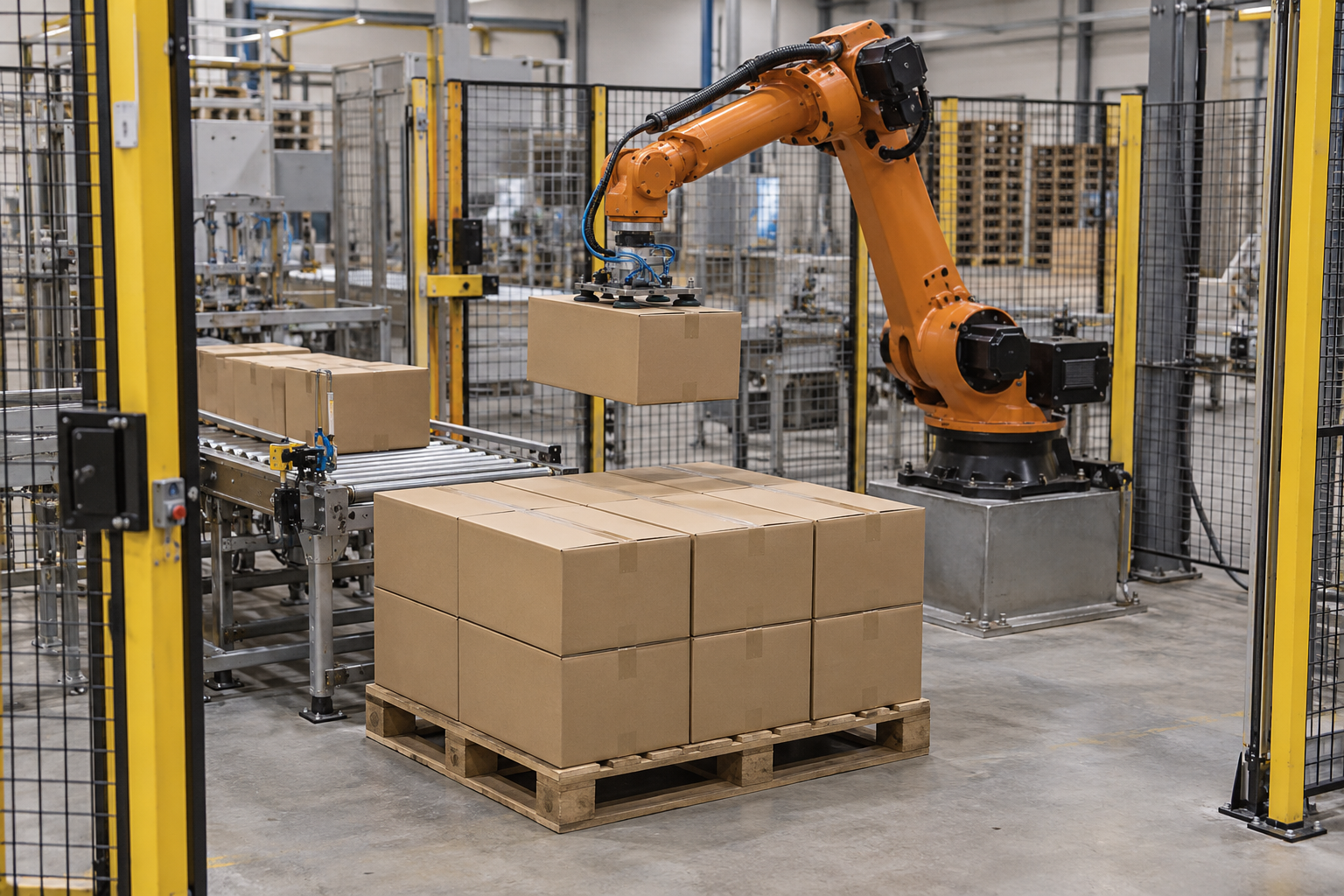
Consider a hypothetical Portuguese factory adding a palletising robot and automated transport to an existing conveyor line. The robot supplier, mobile-equipment manufacturer and local integrator may each provide a credible product. The customer still needs clarity about who covers the interfaces and takes responsibility for the combined installation.
Before a firm quotation, the discussion should establish:
- Who defines the interfaces between the conveyor, robot cell and transport equipment?
- Which organisation takes responsibility for the completed machinery or assembly?
- Who reviews changes to the existing installation and supplies the relevant evidence?
- What will be tested before shipment and after installation, and who accepts the results?
- Who handles faults involving more than one supplier?
Where a retrofit is involved, Article 18 of the Machinery Regulation assigns manufacturer obligations to the person carrying out a legally substantial modification. Article 3(16) sets specific safety and protective-measure criteria; an upgrade does not automatically qualify.
That determination belongs with the responsible technical specialists. The commercial team’s task is to make sure it is addressed, priced and assigned before promises become contractual commitments.
Ask what the software actually does
The word “intelligent” tells a buyer little about a machine’s safety architecture.
Annex I, Part A, of the Regulation includes safety components and certain embedded safety systems using self-evolving machine learning, with mandatory notified-body involvement. The applicable route depends on the defined function and category, rather than an “AI-enabled” or “collaborative” label.
A useful sales discussion therefore asks which functions the software performs, what can change after delivery and who controls those changes. A warehouse application that assigns transport jobs raises different questions from software responsible for a protective function.
For connected equipment, the Commission also highlights protection of compliance-relevant software, data and safety controls. Buyers should establish who approves remote access, manages updates and responds if a software change affects operation.
These are concrete questions for the manufacturer’s engineers. A commercial representative can gather the customer’s requirements and coordinate the answers without making an independent safety judgement.
Make the evidence easy to follow
Procurement discussions work better when each requested item has an owner, a delivery date and an agreed purpose.
For the hypothetical factory, a working record might distinguish a layout awaiting customer approval, an interface description due from the integrator, operating instructions required for local users and an acceptance procedure still under discussion. “Documentation pending” is too vague to guide the next meeting.
The manufacturer retains responsibility for the technical documentation and applicable conformity assessment. Customer handover requirements should be distinguished from the complete technical file maintained for regulatory purposes.
Article 10(7) permits digital instructions under specified conditions; digital-only documentation is not a universal requirement.
Commercial preparation should also cover the information people need to operate and maintain the equipment: available languages, training, spare parts, access to support and the arrangements for recovering from an interruption. These items influence whether the customer can adopt the proposed solution.
How Myralbe moves the discussion forward
Myralbe’s work in automation and intralogistics begins with the manufacturer’s application, product scope and delivery capabilities. We identify relevant plant teams, machinery builders and integrators, then establish who specifies the equipment, evaluates alternatives and authorises purchasing.
Initial outreach leads to questions about the actual operation: what moves, the load formats, transfer points, existing equipment, operating rhythm and planned changes. Confirmed information is distinguished from assumptions and questions still awaiting a customer response.
Where the next decision requires technical input, we connect the customer conversation with the manufacturer’s specialists. A useful meeting has a specific purpose: review an interface, settle the evaluation scope or clarify what the supplier needs before quoting.
Where agreed, Myralbe can also represent the manufacturer in direct customer visits. A site meeting can bring operations, maintenance and the local partner together around the equipment and conditions being discussed.
We record the outstanding questions, responses and next actions in Myralbe MI or an agreed CRM, then follow the quotation and subsequent decisions. Engineering, safety validation and conformity assessment remain with the responsible manufacturer, integrator and qualified specialists.
Develop machinery sales with a clearer path to purchase
If you supply machinery, automation equipment or intralogistics technology, tell us which applications you serve and where discussions with buyers are slowing down.
Contact Myralbe to discuss customer development in Spain or Portugal, local representation and the continuing commercial work needed to progress an opportunity.