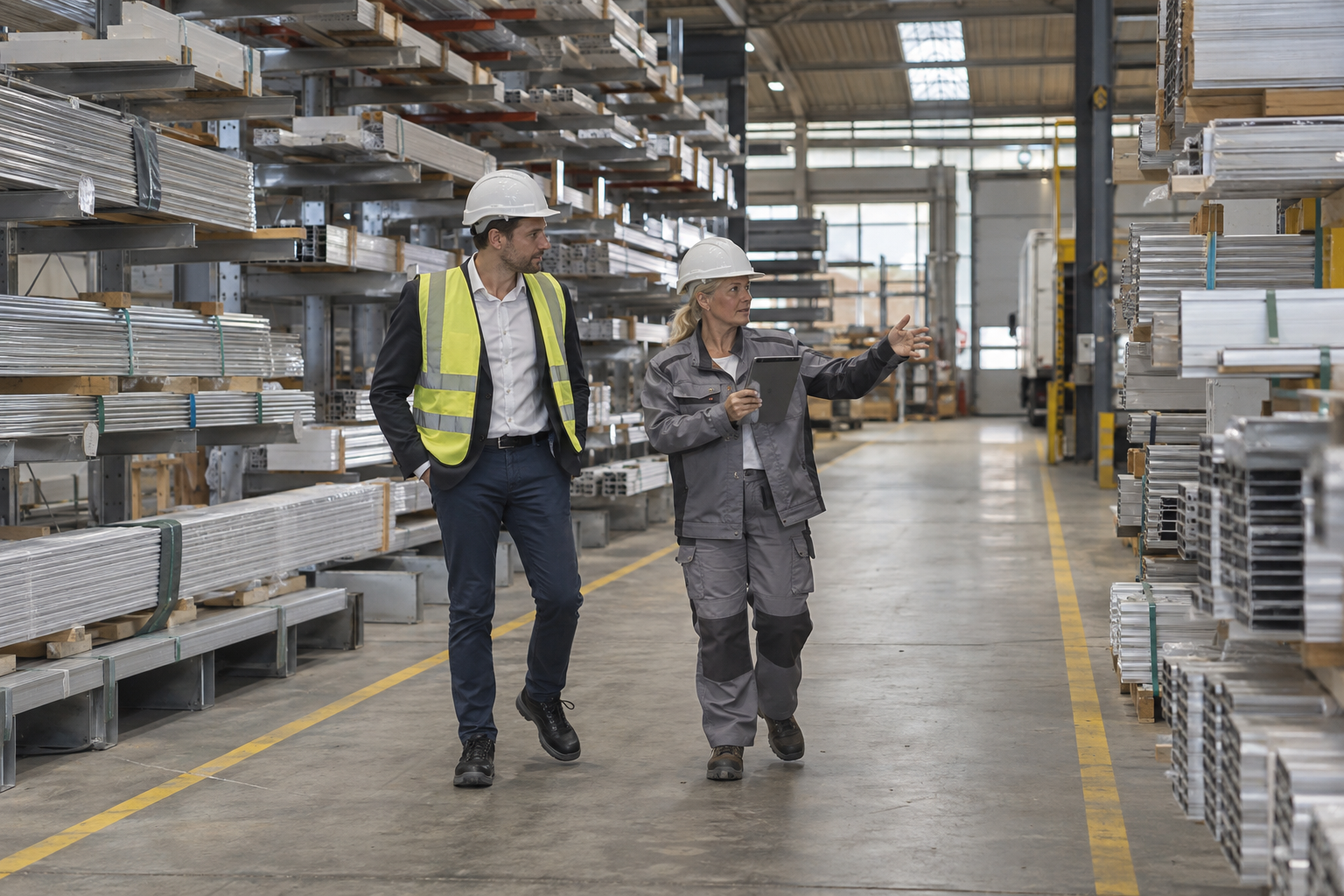
A company that manufactures aluminium profiles or sells steel sections is a plausible account for a long-load handling supplier. That does not yet mean it needs another truck, a different storage arrangement or an automated transport system.
The commercial task is to establish what moves through the site, how it is handled and whether there is a reason to change. For international equipment manufacturers developing Spain and Portugal, those details determine which accounts deserve technical attention.
Start with the unit actually handled
“Aluminium”, “steel” and “timber” describe materials. They do not define the load an operator picks up.
The useful starting point is the unit being moved: a single profile, a strapped bundle, a pack of boards, a stillage or a customer order assembled from different products. Commercial preparation should establish:
- Typical and maximum length, width, height and weight of the complete handled unit.
- Packaging, supports and lifting interfaces, including whether the arrangement changes between suppliers or product families.
- How the load is presented for collection and where it must be deposited.
These distinctions are reflected in Combilift’s equipment-selection guidance, which identifies load dimensions, weight, storage layout, aisle width and operating conditions among the factors affecting selection.
Myralbe gathers the information available from the customer and identifies what needs confirmation. A catalogue dimension or photograph should remain labelled as documentary evidence until the operating team confirms its relevance.
A six-metre profile is only part of the application
Consider a hypothetical account whose website shows six-metre aluminium profiles. Research establishes that the company handles a potentially relevant product, but bundle weights, equipment and internal routes are unknown.
An initial conversation might confirm the profile length while revealing that the site receives material in stillages and moves only a few loads during a normal shift. The discussion then needs to establish whether the difficulty concerns transport, access to storage, unloading or something else.
If the current arrangement works and no change is planned, the account may warrant a later review. If an expansion will increase movements, the next step could be obtaining a representative load specification and arranging a visit with the operations manager.
Neither outcome should be recorded as a qualified opportunity simply because a contact answered the telephone.
Understand the route and the storage around it
A proposed handling machine has to fit an operation that already exists. A useful conversation follows a representative load from arrival to storage, processing and dispatch.
Where does unloading take place? Does the route pass through doors, shared aisles or an outside yard? Where must the load turn, wait or change its orientation? Are materials stored on cantilever racks, in carriers or at floor level, and which locations are difficult to access?
Frequency gives those observations commercial meaning. Ask how many movements occur in a normal shift, when demand peaks and whether operators repeatedly reposition loads to reach another order. A short route used throughout the day presents a different requirement from an occasional movement between buildings.
Automation requires further examination. HUBTEX’s own application guidance highlights changing load dimensions and variety as challenges in automating long-goods handling. That makes carrier consistency and repeatability useful questions for the equipment manufacturer’s technical team.
Establish what could justify a purchasing decision
Existing equipment matters. The customer may already use a sideloader, multidirectional truck, conventional forklift or overhead handling system. The conversation should establish what it does successfully and where the customer reports a limitation.
A reason to invest could be a new storage layout, an additional shift, equipment renewal, repeated product damage or a planned change in the loads handled. Each needs enough detail to understand the consequence and the timing.
The people involved also differ. Warehouse personnel know the daily movements; operations management owns the workflow; maintenance evaluates support requirements; purchasing and management may control supplier approval and expenditure. Identifying these roles helps determine who should attend the next discussion.
Turning qualification into local commercial activity
Myralbe’s work in automation and intralogistics connects this preparation with direct account development in Spain and Portugal.
We approach relevant people in Spanish or Portuguese, coordinate with international manufacturers in English and maintain the commercial conversation as requirements become clearer. Where useful, our mandate includes face-to-face sales meetings and customer visits.
A visit has a defined purpose: understand the route, review the available load information and bring the right customer personnel into the discussion. With the customer’s agreement, photographs, layouts and operational notes can support the manufacturer’s assessment. Equipment selection, capacity calculations, engineering and safety validation remain with the responsible specialists.
Myralbe MI records the source of each relevant fact, contact history, missing information and the next action with its owner. Research, contact, customer confirmation and qualification remain distinct stages.
Follow-up then addresses the actual dependency: a missing weight, a technical response, a visit date, quotation feedback or a later investment review. This keeps the relationship connected to a reason for continuing.
Find the applications your equipment can serve
If you manufacture long-load handling equipment, specialised trucks or associated storage technology, contact Myralbe with your product scope. We can discuss which customer operations to investigate and the local commercial work needed to progress them.